CS2 Marketplaces vs the Steam Market: Custody, Fees, and the 30% Gap
Every CS2 player starts on the Steam Community Market, and most never leave. That inertia has a price: the same skins routinely trade a quarter to a third cheaper on third-party marketplaces, and money that enters a Steam wallet never comes back out. This is the structural comparison — not "Steam bad, third-party good," but exactly what each model gives up and when each one is the right call.
Two different machines
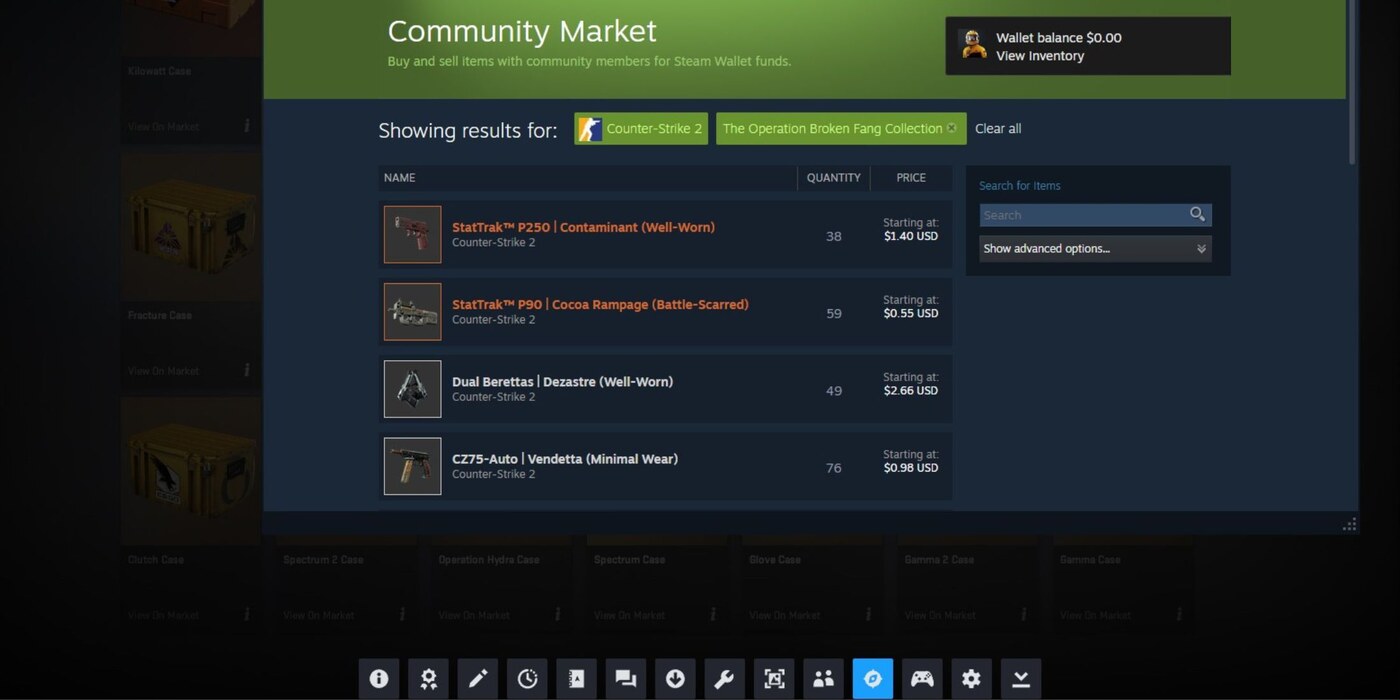
The Steam Market is a closed loop: wallet funds go in, items circulate, and ~15% of every sale stays with Valve. Nothing ever exits as cash. Third-party marketplaces are open loops: real money in, real money out, with sellers cashing to bank accounts and buyers paying card or transfer prices. That single architectural difference — closed versus open — explains nearly everything else in this comparison, from prices to risk profile. The deeper mechanics are in Steam market fees explained.
Why Steam prices run higher
Sellers on Steam receive wallet credit, not money. A seller who wants cash must sell off-Steam instead — so cash marketplaces attract supply priced in real dollars, which clears lower. Meanwhile Valve's ~15% cut pushes Steam listings up: a seller targeting $10 in wallet credit has to list around $11.50. Stack both effects and the measured gap is large — items bought via cross-market comparison average roughly a third cheaper than the Steam price (~36% on our live counter). On individual items the gap swings from near-zero to far wider; the 30% question breaks down where it comes from.
What Steam does better
Honesty requires the other column. Steam settles instantly with zero counterparty risk — no seller can flake, no venue can freeze withdrawals, because there are no withdrawals. There's no KYC, no deposit friction, no FX. For a player who opens cases occasionally and spends the proceeds on more games, wallet lock-in is irrelevant: the money was staying in Steam anyway. And Steam's order book is the deepest in existence for commodity items, with buy orders that fill reliably. If your skin money never needs to become real money, Steam's premium buys genuine convenience.
What third-party marketplaces do better
- Price. The headline reason. The same item, routinely 20–40% cheaper once you compare across venues.
- Real cash, both directions. Sellers exit to bank accounts; buyers aren't pre-committing money to a closed ecosystem.
- Buyer fees near zero on some venues. At the time of writing Skinport charges buyers 0% and several others sit in the low single digits — against a Steam ecosystem where the ~15% seller cut is baked into every listing price.
- Choice of custody model. Instant-settlement venues for speed, P2P venues for lean fees — two architectures, pick per purchase.
The tradeoffs are real too: account creation and eventual KYC, deposit fees that vary by payment method, trade locks on freshly traded items, and venue risk that Steam simply doesn't have. The safety comparison covers how the established venues have handled that responsibility.
Side by side
| Steam Market | Third-party marketplaces | |
|---|---|---|
| Price level | Highest (cut baked in) | ~36% cheaper on average, item-dependent |
| Money out | Never — wallet only | Bank, card rails, per venue |
| Fees | ~15% seller cut | 0%–5% buyer-side, per venue and method |
| Settlement | Instant, guaranteed | Instant (on-site) or hours (P2P) |
| KYC | None | Scales with withdrawal amounts |
| Counterparty risk | None | Low on established venues, never zero |
When each is right
Use Steam when the amounts are small, the money was staying in Steam anyway, or you need a guaranteed instant buy of a commodity item. Use third-party marketplaces when you're deploying real money at any scale — because a ~36% average discount compounds brutally over a buying habit — or when you ever intend to cash out. And if you do go third-party, don't swap one loyalty for another: no single venue is cheapest every day, so the venue decision should be re-made per item, fees included. That comparison is seconds of work on cs2stacker's cross-market search — one query shows the lowest listing across 10+ venues and the gap to Steam on every item — and it's the entire difference between paying Steam's premium and not.