
Compare CS2 Skin Prices Across Every Marketplace in One Search
There is no such thing as "the price" of a CS2 skin. At any given hour, the same item sits at meaningfully different numbers on Steam, Skinport, DMarket, CSFloat, SkinBaron and half a dozen other venues — and which one is cheapest changes from item to item and from day to day. Comparing before every purchase is the single highest-return habit in skin buying. Here's how to do it properly, and why most comparisons get the answer wrong.
Why the same skin has many prices
CS2 skins trade on independent venues that don't share order books. Each marketplace has its own sellers, its own fee schedule, its own payout rails, and its own crowd of buyers — so each one clears at its own price. Steam runs the famous ~15% seller cut into a wallet you can never cash out, which quietly inflates every Steam listing. Cash marketplaces compete with each other on fees and speed, and their sellers price against their own venue's demand, not the market as a whole. The result is permanent dispersion: structural gaps between venues that never fully close, because moving items between them costs time, fees, and trade locks.
Our own tracking across 10+ integrated marketplaces puts the average gap at roughly 36% below the Steam price for the items our users buy — a number that moves with the market, but has never been small. On any single item the spread between the cheapest and priciest third-party venue is routinely 5–15% by itself.
The manual workflow (and why it decays)
The honest manual version looks like this: open four or five marketplace tabs, paste the exact item name into each, note the lowest listing on each venue, mentally add each venue's payment fee, convert the EUR venues to your currency, and check the item is actually in stock rather than a stale cached number. Done carefully, it takes a couple of minutes per item — and it works. We wrote up the full routine in the 60-second price comparison workflow.
The problem isn't that the workflow is hard. It's that nobody sustains it. The third time you buy the same case, you skip the check "just this once". Venues also update at different speeds, so the number you remember from this morning may be two repricings old — cross-market price lag is real, and it cuts both ways.
What a real comparison must include
Most casual comparisons stop at the sticker price, and the sticker price is not what you pay. A comparison that actually finds the cheapest venue needs four ingredients:
- Payment fees, per method. At the time of writing: Skinport charges buyers 0%, White.Market 2%, DMarket 2.35% + $0.25, CSFloat 2.8% on card, Market.CSGO 3.5% + $0.15, Waxpeer 3.9% + $0.35 by card but 1.5% + $0.35 by bank transfer, and SkinBaron 5% + €0.35 by card but 0% by bank transfer. On a $2 case, a flat $0.35 fee is 17% — flat fees flip cheap-item rankings constantly.
- Currency conversion. SkinBaron quotes in EUR. A comparison in mixed currencies isn't a comparison; convert everything at the live rate before ranking.
- Supply. "No listing today" is a common answer on smaller venues. A venue can't be cheapest if it has nothing to sell — a good comparison shows depth, not just the minimum.
- Freshness. A quote from three hours ago is a rumor. Prices should be re-checked live at the moment you commit.
This is what we mean by effective price: listing price plus fees for the cheapest payment method, in one currency, with supply confirmed. It's the only number worth ranking by.
One search instead of seven tabs
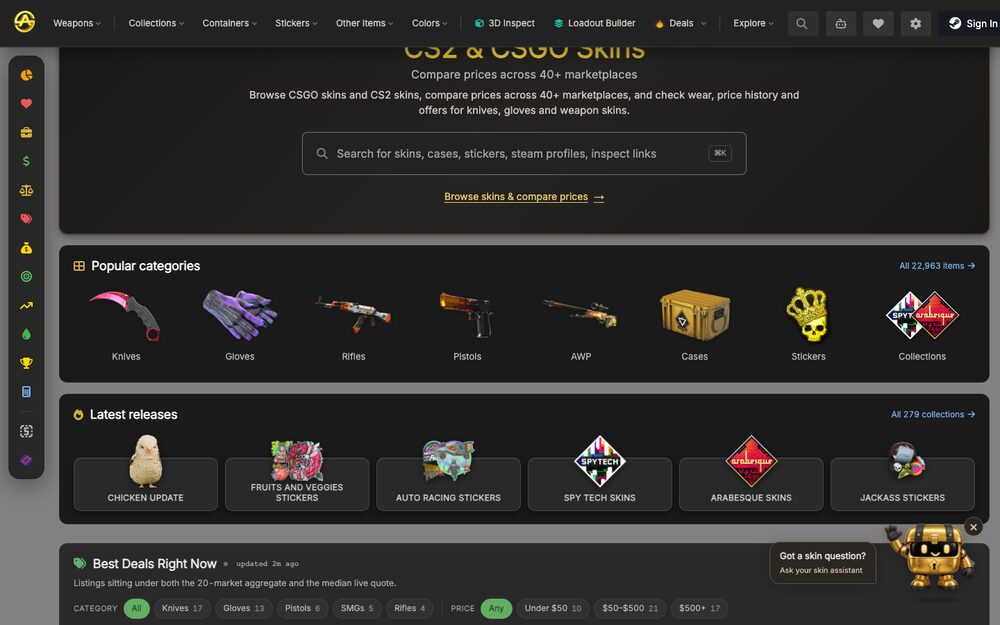
The aggregator approach collapses the whole routine into one query. cs2stack's marketplace runs that search across 10+ integrated venues: every item shows its lowest listing, the venue that has it, the fee-adjusted effective price per payment method, and the discount versus Steam — then routes you to that venue to buy. It's the same comparison you'd do by hand, done on every item, every time, with none of the decay. (How the routing works under the hood is covered in how cs2stack buys cheapest.)
The comparison in numbers
| Approach | Coverage | Fees included | Time per item |
|---|---|---|---|
| Check one favourite venue | 1 venue | No | Seconds — but you overpay silently |
| Manual multi-tab check | 3–5 venues | If you do the math | 2–3 minutes, decays with habit |
| Aggregated search | 10+ venues | Yes, per payment method | Seconds, every time |
The habit that pays for itself
No venue is cheapest for everything — not Steam, not the leanest cash marketplace, not anyone. The buyers who consistently pay less aren't the ones with a secret venue; they're the ones who compare on every single purchase. Whether you run the manual circuit or let an aggregator do it, the discipline is the same: never buy from a single quote.