
Effective Price: the Only Number That Matters When Buying CS2 Skins
Every price-comparison mistake in skin buying reduces to the same error: treating the listing price as the price. It isn't. The price is what leaves your account — listing plus deposit fee plus payment surcharge plus currency conversion — and ranking offers by anything less picks the wrong venue with mechanical regularity. This piece defines the metric properly and works the examples.
The definition
Effective price = listing price + deposit/payment fees (percentage and flat) + FX conversion, computed for the payment method you'd actually use. Formally, for a venue charging p% plus flat f: effective = listing × (1 + p) + f, with f converted to your currency first when it's denominated in another (a €0.35 flat is not $0.35). When a venue offers multiple funding methods with different schedules, the effective price is the minimum across methods — a rational buyer uses the cheap rail.
Worked example 1: the flat-fee ambush
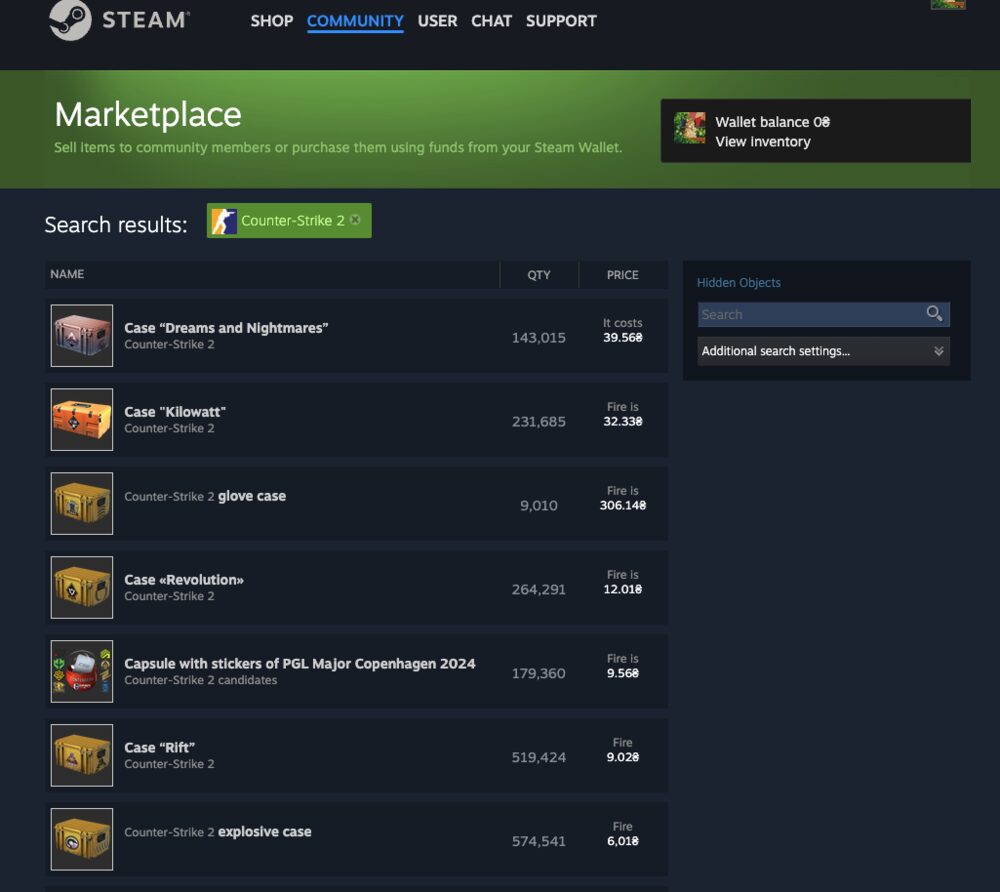
A Kilowatt Case, real numbers from our own engine's history. Venue A lists it at $0.11 with a ~3.5% + $0.15 fee schedule; venue B lists at $0.12 with ~2.8% and no flat. Sticker says A wins by 9%. Effective says: A costs 0.11 × 1.035 + 0.15 = $0.26; B costs 0.12 × 1.028 = $0.12. B wins by more than half. On sub-dollar items the flat fee is the price, and any sticker-sorted list has the order upside down — the general pattern is in zero-fee versus low-fee math.
Worked example 2: the payment-method flip
A €9.00 listing on a EUR venue charging ~5% + €0.35 by card but 0% by SEPA transfer. By card: 9.00 × 1.05 + 0.35 = €9.80. By transfer: €9.00 flat. Same venue, same listing, 9% apart — and whether this offer beats a $10.40 USD-venue alternative depends entirely on which rail you can use and today's EUR/USD rate. This is why our engine computes both methods and shows the winner with a card or bank icon: the method is a coordinate of the price, not an implementation detail.
Worked example 3: the percentage crossover
A $500 knife. Venue A: $496 listing at ~2.8%, effective $509.89. Venue B: $500 listing at ~2.35% + $0.25, effective $512. Venue C: $492 at ~3.9% + $0.35 card — effective $511.89 — or ~1.5% + $0.35 by bank: $499.08. The cheapest sticker (C) is also the cheapest effective price, but only via bank transfer; by card it loses to A. At the expensive end flats vanish and percentages govern, and the ranking still can't be read off the stickers.
What effective price deliberately excludes
- Withdrawal fees and KYC — they're real, but they belong to selling, not buying. Mixing them into a buy decision double-counts for buyers who never cash out. (Selling-side costs here.)
- Delivery speed and venue risk — a P2P venue's hours-long delivery is a genuine cost, but not a monetary one; we treat it as a filter, not a price adjustment. Same for venue trust: vet the venue, then compare prices among the vetted.
- Steam's opportunity cost — wallet lock-in is the one exception worth flagging: a Steam "price" is paid in currency that can never leave the ecosystem, which is why off-Steam comparisons measure items at roughly a third cheaper (~36% on our live counter) despite Steam charging buyers "nothing." That story here.
The sticker-price failure, quantified
| Scenario | Sticker picks | Effective picks | Sticker's error |
|---|---|---|---|
| $0.11 case, flat-fee venue | Venue A ($0.11) | Venue B ($0.12) | −118% |
| €9 skin, card vs SEPA | ambiguous | SEPA rail (€9.00) | −9% if card assumed |
| $500 knife, three venues | Venue C | Venue C by bank only | wrong rail, −2.6% |
Making it a habit (or making it automatic)
By hand, the algorithm is: list every venue stocking your item, write down each listing, apply each venue's fee schedule for your payment method, convert currencies, buy the minimum. It takes two minutes per purchase and most people abandon it within a week — which is the entire case for tooling. The cs2stack grid runs this exact computation on every offer across 10+ integrated venues and sorts by the result; the aggregator explainer shows the machinery. However you do it, the principle survives any tooling choice: a price without its fees and its payment method is not a price — it's a headline.