
What Is a CS2 Marketplace Aggregator? How Cross-Market Search Works
There are a dozen serious places to buy a CS2 skin, and on any given day any of them might hold the cheapest listing for the item you want. An aggregator is the layer that checks all of them so you don't have to: one search, every venue, cheapest price surfaced with its fees included. Here's what that actually means mechanically — where the prices come from, how fresh they are, and what an aggregator can and can't do for you.
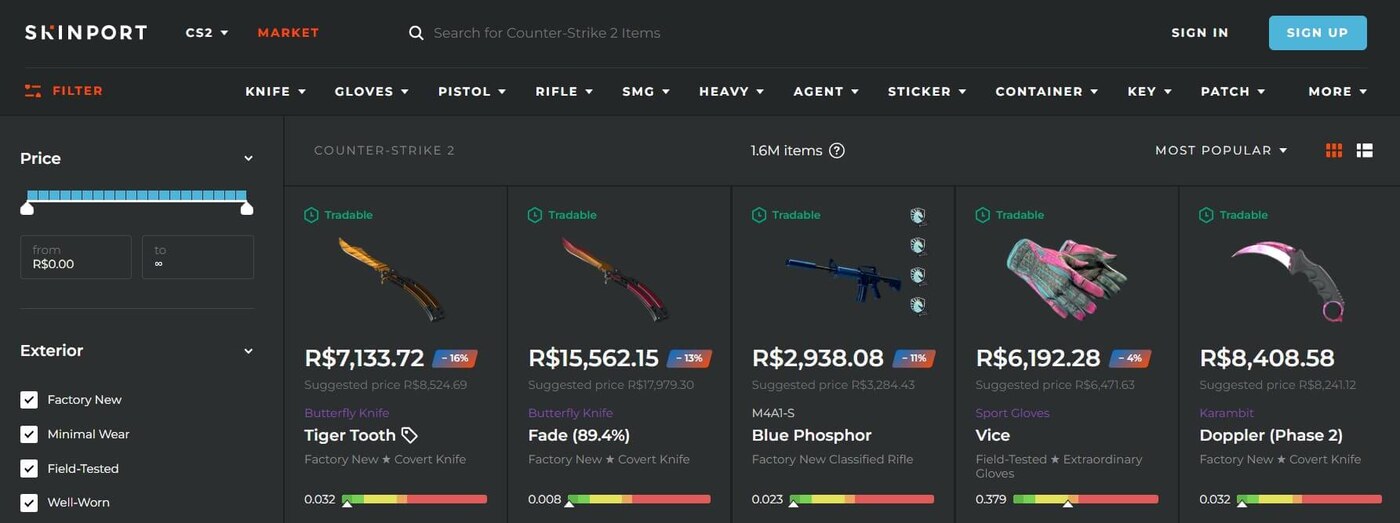
The problem an aggregator solves
CS2 skin prices are dispersed: the same item trades at different prices on different venues because each marketplace has its own sellers, its own fee structure, its own regional user base, and its own refresh rhythm. The gaps aren't trivial — items bought through cross-market comparison average roughly a third cheaper than the Steam price (~36% on our live counter), and venue-to-venue spreads of 5–15% on the same item are routine. Checking six tabs before every purchase captures that spread. Nobody does it manually for long, which is why aggregators exist.
Where the prices come from
Aggregators don't scrape storefronts with a headless browser — the serious ones consume the data channels marketplaces publish on purpose. There are two main kinds:
- Bulk feeds. Several venues publish their entire price list — every item, lowest listing, stock count — as one downloadable file, refreshed every few minutes. One request returns thousands of prices. This is how an aggregator covers a whole catalog cheaply.
- Per-item APIs. Other venues only answer item-by-item queries, sometimes requiring signed requests or API keys. These are rate-limited, so aggregators reserve them for the items people are actually looking at.
A well-built aggregator blends both: bulk feeds keep the broad catalog current, per-item calls fill gaps and re-verify prices at the moment of purchase. The blend matters because feeds lag reality by minutes — a price that's five minutes old is fine for browsing and not fine for clicking Buy, which is why the good ones re-check live before routing you to checkout.
The fee math is the hard part
Raw listing prices are the easy half. The cheapest sticker price is frequently not the cheapest effective price once deposit and payment fees land: at the time of writing, one venue charges ~3.9% + $0.35 on card deposits while another charges buyers nothing, and a third charges 5% + €0.35 by card but 0% by SEPA bank transfer. An aggregator that ignores fees actively misleads you on cheap items, where flat fees dominate. The effective price — listing plus every cost between your bank and the skin, computed per payment method — is the number a real aggregator sorts by.
What an aggregator is not
Worth being precise about the limits, because the category gets oversold:
- It's not a marketplace. An aggregator holds no inventory and never touches your items. You buy on the destination venue, under that venue's rules, protections, and KYC requirements.
- It can't fix a venue's problems. If the cheapest listing sits on a P2P venue, delivery still waits on a human seller. If a venue's withdrawals are slow, they're slow whether you arrived via aggregator or bookmark.
- It's only as honest as its fee table. An aggregator that sorts by sticker price, or takes referral money to favor a venue, ranks against your interest. Check whether the tool shows the fee breakdown per offer.
A worked example: how cs2stack does it
Full disclosure — this is cs2stack's blog, and cs2stack is an aggregator, so here's our own machinery as the example. Every morning the whole catalog (~6,000 items) is rebuilt from the bulk feeds of 10+ integrated marketplaces and shared with every visitor. Searches outside the catalog trigger live per-item fetches, which are then cached for the next visitor. Each card shows the lowest listing, the venue holding it, and the gap to Steam; each offer in the detail view is sorted by effective price with the winning payment method shown — card or bank transfer — using the fee schedules above. When you click through to buy, the price is re-checked live, because a browsing-grade price and a buying-grade price are different things. And because no venue is cheapest every day, the venue column changes constantly — which is the entire reason the product exists. All of it is inspectable live on the cs2stacker grid: free, no account needed to browse, and it holds no items of its own.
The scorecard
| Aggregators do | Aggregators don't |
|---|---|
| Search 10+ venues in one query | Hold items or process your payment |
| Sort by effective price, fees included | Override the destination venue's rules |
| Re-verify prices live at buy time | Guarantee a feed price is still listed |
| Show the winning payment method | Make a slow P2P delivery instant |
Should you use one?
If you buy skins more than once a month, the math is lopsided: a comparison costs seconds and the venue-to-venue spread on a typical item pays for the habit many times over. The manual alternative — six tabs and a spreadsheet — produces the same answer with more friction, so most people quietly stop doing it and default to one venue, donating the spread. An aggregator just makes the correct habit effortless.