
CS2 Price Comparison Tools in 2026: What Actually Works
Every serious skin buyer eventually asks the same question: how do I stop overpaying without turning every purchase into a research project? The answer in 2026 comes in three shapes — raw marketplace tabs, tracker sites, and live aggregators — and they are not interchangeable. Here's what each one is actually good at, where each one quietly misleads you, and the checklist to run on any tool before you trust it with your money.
Option 1: the marketplaces themselves
The most primitive comparison tool is a row of browser tabs — Skinport, DMarket, CSFloat, SkinBaron, Steam — each searched for the same item. It's free, it's always live, and the number you see is a number you can actually click. The cost is your time and your discipline: five searches per item, fee math done in your head, EUR-to-USD conversion for the European venues, and the whole ritual repeated for every purchase because prices move. As a spot check it's unbeatable; as a system it collapses within a week. We've documented the tight version of it in the 60-second workflow, and even that only survives if you buy rarely.
Option 2: tracker and database sites
Tracker sites aggregate historical prices and charts across venues — think of them as the Bloomberg terminals of skins. The best known, Pricempire, lines up many marketplaces per item and adds portfolio tracking; database sites like CSGO Stash catalogue every item in the game with Steam prices attached (we cover where those numbers come from separately). Trackers are excellent for research: trend lines, historical context, venue coverage in one view. Their limits show at the moment of purchase. Listed prices are often minutes to hours stale — enough for cross-market lag to bite — many quote sticker prices without payment fees, and a tracker can't complete a purchase, so there's always a final hop to the venue where the real, current price may differ from the one that sent you there. Our full roundup of trackers lives in skin price tracker tools 2026.
Option 3: live aggregators
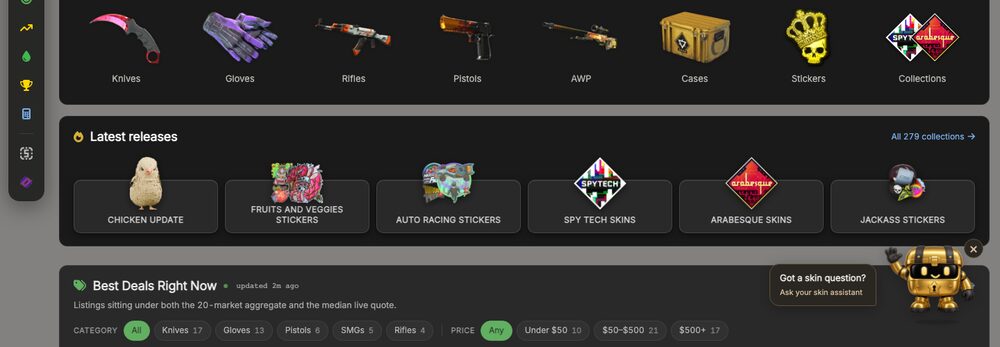
The third shape is the aggregator that treats the comparison itself as the product: one search that returns each item's lowest live listing across venues, adjusted for fees, with a route to buy at the winner. The entry we know best — because we build it — is the cs2stacker marketplace: free to use, 10+ integrated venues, and every card shows the winning venue, the discount versus Steam, and an effective price that includes each venue's payment fees per method (card versus bank transfer changes the winner more often than you'd think). It also keeps the browsing ergonomics of the reference tools — Stash-style category drill-down, a CSFloat-style float bar for wear filtering — so research and purchase happen in the same grid. Its structural limit is the honest limit of any aggregator: purchases complete on the venues themselves, and it can only rank the venues it integrates. Ask any aggregator which venues it covers and how fresh its quotes are before trusting the ranking.
The five questions to ask any comparison tool
- Are fees included? At the time of writing, buyer-side costs range from 0% (Skinport) through 2–4% (White.Market, DMarket, CSFloat, Market.CSGO, Waxpeer) to 5% + €0.35 (SkinBaron by card — 0% by bank transfer). A sticker-price ranking is wrong on cheap items almost by default.
- How fresh is the quote? "Updated daily" is fine for research, dangerous for buying. Look for live re-checks at purchase time.
- Does it show supply? A venue with no stock can't be the answer. Depth matters as much as the minimum.
- One currency? EUR venues must be converted at a live rate, not ignored.
- Can you act on it? A number you can't click is a research artifact. The gap between "cheapest an hour ago" and "cheapest now" is where overpays hide.
Which tool for which job
| Tool type | Best for | Weakness |
|---|---|---|
| Marketplace tabs | Spot-checking one item right now | Slow, manual fee math, doesn't scale |
| Trackers & databases | Research, charts, historical context | Stale quotes, sticker prices, no purchase |
| Live aggregators | Buying at the fee-adjusted minimum | Only as good as venue coverage |
In practice the combination wins: a tracker for deciding what to buy, an aggregator for deciding where — and the occasional manual tab check to keep everyone honest. Whatever the tooling, the principle from comparing across every marketplace holds: never buy from a single quote.