How to Buy CS2 Skins in 2026: the Complete Walkthrough
Buying a CS2 skin is a five-minute job once you know the terrain, and a week of second-guessing when you don't. This is the whole map in one page: where skins are actually sold, what each kind of venue asks of you, how the money moves, how the item reaches your inventory, and the small preparation steps that make the first purchase boring — which is exactly what a first purchase should be.
The two worlds: Steam and everywhere else
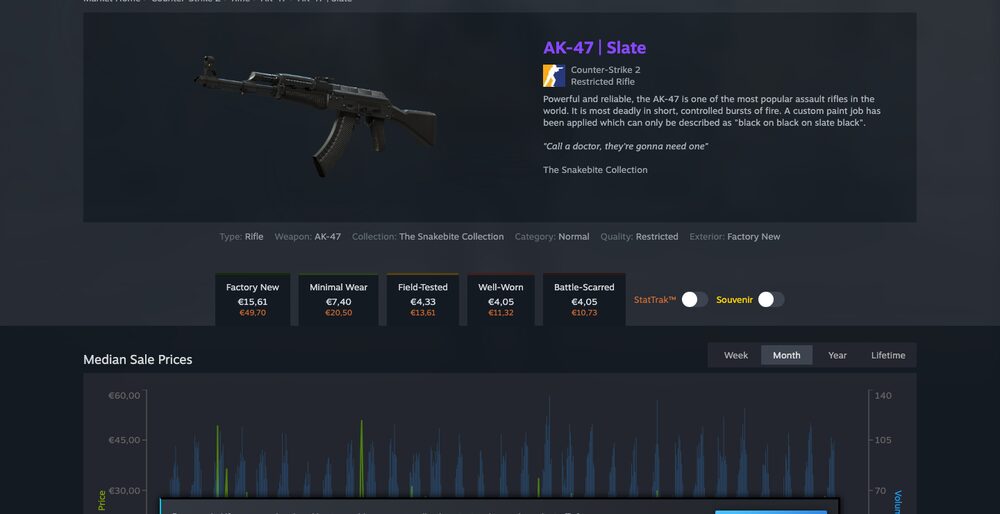
Every CS2 skin trades in two parallel markets. The Steam Community Market is Valve's own venue: convenient, enormous, and expensive — sellers give up roughly 15% per sale, proceeds land in a wallet that can never be cashed out, and both facts are priced into every listing. Third-party marketplaces (Skinport, DMarket, SkinBaron, CSFloat and a dozen others) run on real money instead of wallet credit, which is why the same item routinely costs less there. Across our own automated buying, the gap has averaged ~36% below the Steam price — the single most important number in this guide, and the reason the rest of it is mostly about the third-party world. The structural causes are worth understanding once; we've broken them down separately.
Step 1 — prepare the Steam side
Whatever venue you buy on, the item ends up in a Steam inventory, so the account comes first:
- Steam Guard Mobile Authenticator, active for 15+ days. Without it, trades are held or blocked — this is the classic first-buy surprise, so start the clock now.
- A public inventory (or at least visible to the venue) so listings and deliveries can be verified.
- Your Trade URL (Steam → Inventory → Trade Offers → "Who can send me Trade Offers?"). Third-party venues need it to deliver items.
Step 2 — choose the venue for this item
Here's the part most guides get wrong: there is no best marketplace, only a best marketplace per item, per day. Venues differ on three axes — price, fees, and delivery model — and the cheapest listing moves between them constantly. A quick sketch of the delivery models:
| Model | How you receive the item | Examples |
|---|---|---|
| On-site inventory | Instant — the venue holds stock and trades it to you | DMarket, SkinBaron, Market.CSGO |
| Peer-to-peer | The seller sends a Steam trade offer; minutes to hours | CSFloat, Waxpeer |
| Bot-mediated | Venue bots deliver after the seller deposits | Skinport |
Rather than opening six tabs, compare once: a cross-market search shows each item's lowest live price and which venue holds it. Or skip the venue question entirely: the cs2stack marketplace searches 10+ venues at once, shows the winner with fees already counted, and sends you straight to its checkout — it holds nothing and adds nothing on top. Our venue-by-venue cheapness guide covers the tendencies, but treat them as weather, not climate.
Step 3 — mind the fees, not just the sticker
The listed price is not what you pay. At the time of writing, buyer-side payment costs range from 0% (Skinport card, SkinBaron by SEPA bank transfer) through 2–3.9% plus small flat fees elsewhere (DMarket 2.35% + $0.25, CSFloat 2.8%, Waxpeer 3.9% + $0.35 by card). On a $2 case, a $0.35 flat fee is 17.5% — flat fees flip cheap-item rankings all the time. The honest comparison is the effective price: sticker plus every fee for your payment method. Card vs bank transfer alone can swing several percent.
Step 4 — pay, receive, verify
Fund the purchase (card, bank transfer, PayPal or crypto depending on the venue — PayPal and crypto have their own guides), confirm the exact item name and wear before paying (names are a minefield), then accept the delivery: instant on on-site venues, a trade offer to accept on P2P ones. When the item lands, check float and pattern match what you bought. That's it — you own a skin.
The routine that compounds
One good purchase is luck; a routine is an edge. Compare before every buy, prefer the venue that's cheapest today, pay by the cheapest rail, and if you're accumulating rather than impulse-buying, consider spreading purchases over time instead of going all-in on one afternoon's prices. Everything else in skin buying — sniping, standing orders, bulk runs — is this routine with more automation bolted on.