How to Buy CS2 Skins Cheaper than Steam, Consistently
"Cheaper than Steam" isn't a trick or a coupon — it's the market's normal state, available to anyone who compares before buying. Our own automated purchases have averaged ~36% below the same-day Steam price, measured across hundreds of buys. But that average is built from four separate, stackable edges, and knowing which is which turns a slogan into a system you can actually run.
Edge 1 — leave Steam (the big one)
The bulk of the discount comes from a structural fact: Steam sale proceeds are locked wallet credit, so sellers who want real money list on cash marketplaces and accept lower prices for the privilege. Steam's ~15% cut gets priced into its listings on top. The result is a permanent gap between the Steam price and the cash price of the same item — the Steam premium. You collect this edge by doing nothing more sophisticated than buying anywhere else reputable. Size: the majority of the ~36%; deepest on commodity items like cases, thinner on hyped liquid skins.
Edge 2 — pick the right venue per item
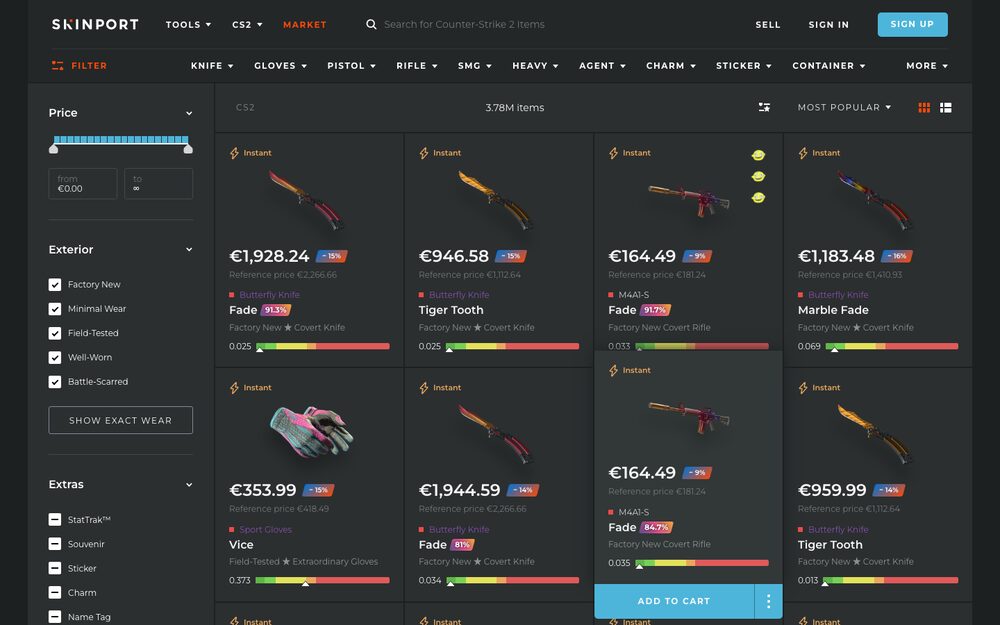
Off-Steam venues disagree with each other too. Seller populations, deposit flows, and fee schedules differ, so on any given day the same skin might be 5–15% apart between two perfectly reputable marketplaces — and the cheapest venue rotates. Loyalty to one site quietly costs a few percent forever; venues also reprice at different speeds, which is where many of the gaps come from. You collect this edge with a cross-market comparison before every buy — the cs2stack marketplace exists to make that a single search instead of six tabs, and it charges nothing for the answer. Size: mid-single digits on average, more on off-meta items where venues genuinely disagree.
Edge 3 — pay through the cheap rail
Checkout fees vary from 0% to ~5% + flat depending on venue and payment method (at the time of writing: Skinport 0% by card, SkinBaron 0% by SEPA bank transfer, others between 2% and 3.9% plus small flats). On cheap items the flat components dominate and can invert venue rankings entirely. You collect this edge by comparing effective prices — sticker plus fees for your rail — and using bank transfers for big tickets. Size: 2–5% typically; absurdly more on sub-$1 items.
Edge 4 — let time work: dips and standing orders
Prices breathe. Sellers flood venues after big case openings and game updates; quiet hours and seasons exist; individual sellers underprice to exit fast. You collect this edge two ways: patience (buy on red days, not hype days — dip-buying without pretending to predict the market) and standing orders that sit below market and fill when an impatient seller crosses them. Size: unbounded but irregular — this is where the occasional 20%+ single-item steal lives, courtesy of sellers in a hurry.
The system, assembled
| Edge | Effort | Typical size |
|---|---|---|
| Off-Steam venues | None — just don't buy on Steam | Most of the ~36% |
| Per-item venue choice | One comparison per buy | ~3–10% |
| Payment rail | One decision per checkout | ~2–5% |
| Timing & standing orders | Patience or automation | Irregular, sometimes large |
Expectations, honestly set: the ~36% is an average across many buys, dominated by categories with deep discounts. A single hyped AK skin might only be 15–20% under Steam on its best venue today. The system doesn't promise every item at a third off; it promises you never pay more than the market's best available price — and over months of buys, that discipline is exactly what the average looks like. The four edges are independent, so they compound; the stacking article runs a full worked example.