
Stacking Discounts in CS2: Venue, Payment, Timing, Patience
Most buyers collect one discount — they've heard skins are cheaper off Steam, they pick a site, done. But the off-Steam gap is only the first of four edges, and the four are independent: each applies on top of the others. Collected together, they don't add — they compound. Here's each edge, its price tag in effort, and a worked example of what the full stack does to a $100 budget.
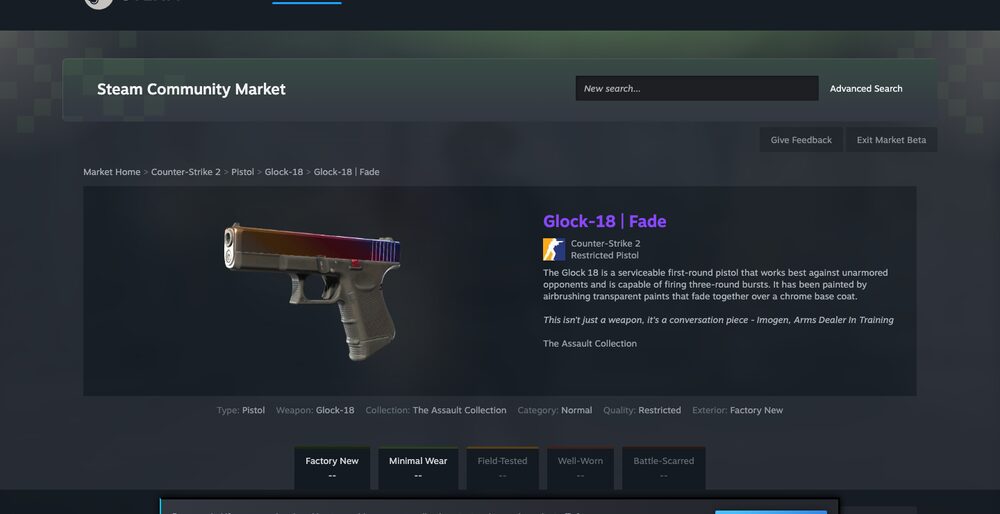
Edge 1 — the venue layer (free)
Buying anywhere reputable off Steam collects the structural discount: cash marketplaces price below Steam because sellers there get real money instead of locked credit. Our purchase ledger puts the average at ~36% below same-day Steam prices. Effort: zero beyond making an account. If you stop reading here you've captured the biggest edge — but you're leaving the other three on the table. (Full mechanics: the consistency guide.)
Edge 2 — the comparison layer (one search)
Reputable venues disagree with each other by mid-single digits on a normal day, more on off-meta items, and the cheapest one rotates. Comparing the exact item across marketplaces before each buy — one cross-market search, which is literally the cs2stack marketplace's home screen — reliably shaves another few percent off the venue you would have defaulted to. This is the edge loyalty destroys: no single venue is cheapest for even a week straight.
Edge 3 — the payment layer (one decision)
The same checkout costs 0% to ~5%+ depending on rail and venue (at the time of writing: 0% by card on Skinport, 0% by SEPA on SkinBaron, 1.5–3.9% plus flats elsewhere). Flat fees savage cheap items — the card fee table shows a $0.35 flat turning into double-digit percentages under $5 — while percentage fees bite big tickets, where bank transfers win. Picking the cheap rail per purchase is worth 2–5% forever.
Edge 4 — the patience layer (automation or discipline)
Prices dip after updates and big unlock waves, and individual sellers underprice to exit fast. Two collection methods: buy on red days rather than hype days, and park standing orders below market that fill when someone impatient crosses them. Irregular but real — this layer produces the occasional single-buy steal that the other three never will.
The worked example: $100 of cases
Target: a case at $1.50 on Steam. The stack, applied one layer at a time (illustrative numbers in the ranges above):
| Layer | Price paid | Cases per $100 |
|---|---|---|
| Steam, no comparison | $1.50 | 66 |
| + off-Steam venue (−34%) | $0.99 | 101 |
| + best venue today (−4%) | $0.95 | 105 |
| + cheap rail vs 3.5%+$0.15 batched (−3%) | $0.92 | 108 |
| + bought on a dip week (−5%) | $0.874 | 114 |
Same $100: 66 cases versus 114 — 73% more items, of which the venue layer contributed most but the quiet layers added a third more units on top of layer one alone. And because edges 2–4 repeat on every purchase, an accumulator running this weekly compounds the difference into something that looks, after a year, like a second portfolio. This is the entire logic of systematic buying: none of the layers is clever, all of them are repeatable.
What the stack costs
Honestly: the venue layer is free, the comparison layer costs a minute per buy, the payment layer a thought, and the patience layer either discipline or software. That's the real trade — a modest tax in attention for a large, permanent discount. Automation exists precisely to pay the attention tax for you: comparison, fee math, scheduling and standing orders are all mechanical, which is why we built a bot to run them daily.