
First-Time CS2 Skin Seller Checklist: From Inventory to Bank
First sales go wrong in predictable ways: the venue gets picked by vibes instead of payout rails, KYC ambushes the withdrawal, the price gets copied from Steam and sits unsold for a month. Every one of those is avoidable by doing six steps in the right order. This is the order.
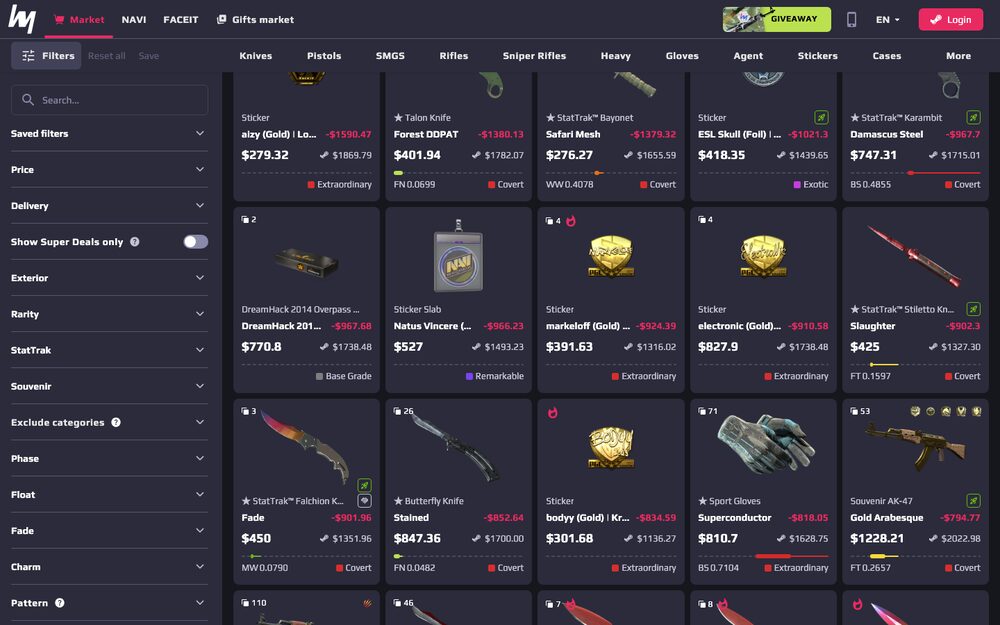
Step 1 — Pick the venue backwards: payout rail first
Most guides start with fees. Start instead with the question that actually strands money: how does this venue pay out, in my country, and does that rail work for me? Bank transfer, PayPal, crypto — check the venue's own withdrawal page for rails, fees, and minimums before anything else. A venue with a slightly higher commission that pays straight to your bank beats a cheaper one whose rails you can't use. Then, and only then, compare commissions (the 2026 comparison) and read the venue's review — Skinport, DMarket, SkinBaron, CSFloat. Note the architecture while you're there: P2P venues have you deliver by trade offer after the sale; on-site venues take a deposit first — the difference explained.
Step 2 — Verify your identity before listing anything
Every serious venue requires KYC before meaningful withdrawals. Do it while nothing is at stake: upload the documents, wait out the review, confirm a test-sized withdrawal works if you can. First-timers who skip this step discover it at the worst moment — money inside, documents pending, payout frozen for days. Verification done in advance is the single largest time-saver in the whole pipeline (the speed math).
Step 3 — Price against reality, not against Steam
The Steam number is not a cash price — cash markets trade well below it, mirroring the discount buyers enjoy off-Steam. Price from what your item actually clears for across venues: pull up the item on cs2stack's cross-market grid — it shows the current low on each of 10+ venues plus the gap to Steam — then look at the cheapest asks on your chosen venue and position accordingly. Slightly under the cheapest ask sells in hours; at Steam sticker it decorates your listing page for a month. Understanding why prices differ across sites turns this from guesswork into a two-minute check.
Step 4 — List it, and ignore the DMs
The moment you list anything valuable, the "buyers" appear: direct offers above market, off-platform payment, urgency. All of it is the same scam in different costumes, and rule one never changes — payment and item travel through the venue, or the deal doesn't exist. The full seller-side threat list is in selling safely; skim it once before your first listing and the DMs become background noise.
Step 5 — Deliver exactly what the venue asks, promptly
On a P2P venue, you'll send a trade offer when the item sells — check the recipient on the trade screen itself, then deliver within the window; slow delivery earns penalties and refunds. On an on-site venue, delivery already happened when you deposited. Either way the item may carry Steam's 7-day trade lock if it arrived in your inventory recently — how locks propagate — so first sales move fastest with items you've held a while.
Step 6 — Withdraw, and expect the first one to be the slowest
First payouts commonly get extra review: a hold, a re-check, sometimes another document. It's normal, not a red flag. Pick the rail you validated in step 1, mind the minimums (batch small balances rather than paying flat fees repeatedly), and compare against typical rail speeds before worrying. What arrives will match the funnel you can pre-compute in seller payouts compared.
After the first sale
The second sale takes a tenth of the effort: the account is verified, the rails are proven, and the pricing check is a reflex instead of a research project. Two habits are worth installing while the process is fresh. Record the sale — item, date, price, fees, payout — in a spreadsheet, because tax questions eventually arrive in most countries and marketplace history is easier to export now than to reconstruct later. And note what your item actually cleared for versus what you expected from the cross-market check: after a few sales, that gap tells you whether your pricing instinct runs hot or cold, which is worth more than any guide. Sellers who trim regularly rather than in one emergency batch also dodge the worst timing traps — the when-to-sell question gets easier when no single sale has to be perfect.
The mistakes, ranked by cost
- Taking a direct "buyer's" offer — the only mistake on this list that costs everything.
- Pricing at Steam sticker — costs weeks, then gets repriced down anyway.
- KYC after the sale — costs days, at the exact moment you wanted the money.
- Instant-selling illiquid items for convenience — costs the widest spread on the board; when the button is actually right.
- Ignoring withdrawal minimums — costs a stranded $8 balance you'll forget about.
The one-line version
Rails, then KYC, then a reality-based price, then on-platform everything — do the boring steps in order and your first sale is an anticlimax, which is exactly what it should be.