
How to Sell CS2 Skins for Real Cash in 2026
Every month someone discovers the hard way that the Steam Community Market doesn't pay money. It pays Steam wallet balance — spendable on games and more skins, withdrawable to nowhere. If you want euros or dollars in a bank account, you have exactly two real paths, and both run through third-party marketplaces. Here's the full map: how each path works, what it costs, and how long it takes.
Why Steam can't be the answer
Valve's market is a closed loop by design. Sell a knife there and roughly 15% disappears in fees — the full fee breakdown is here — and the remainder lands in a wallet that can never touch a bank. That's fine if you were going to buy games anyway; it's a dead end if you need cash. Everything below is about leaving the loop.
Path one: list on a third-party marketplace, then withdraw
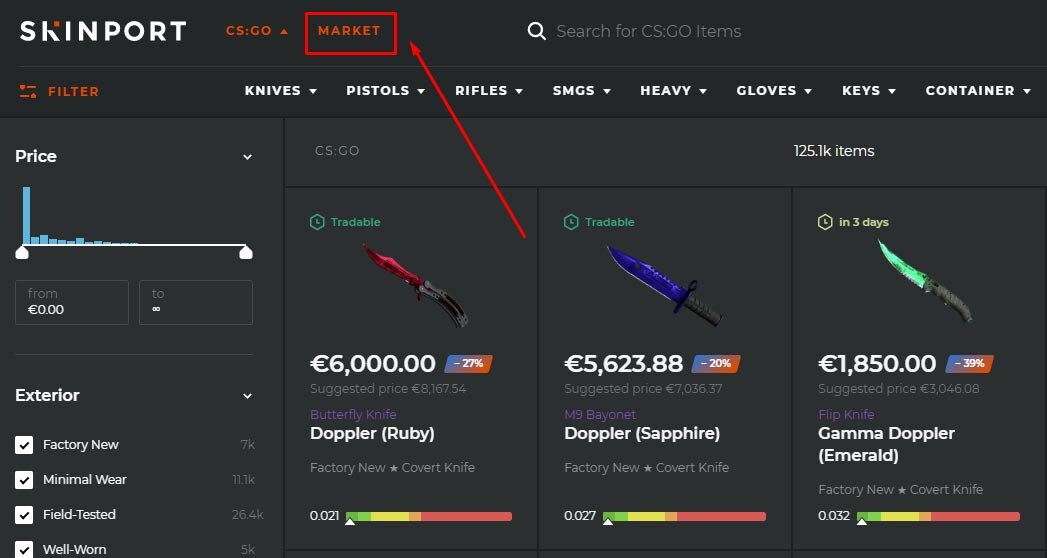
This is the patient route and usually the best-paying one. You pick a cash marketplace — Skinport, DMarket, SkinBaron, CSFloat and others — list your item at a price you choose, wait for a buyer, then withdraw the proceeds to a bank account, PayPal, or crypto, depending on what that venue offers in your region.
Three things decide what you actually receive:
- The sale price. Cash prices sit below Steam sticker — the same gap that lets buyers pay roughly a third less off-Steam works against you as a seller. Price against cross-market reality, not against what Steam shows: cs2stack's marketplace grid puts the live lowest listing on 10+ venues side by side, which is exactly the competition your listing has to beat.
- The seller commission. Every venue takes a cut, and the figures range from low single digits to around ten percent depending on venue and item — per each venue's published schedule, which changes; verify before listing.
- The withdrawal. Payout rails carry their own fees and minimums, and speeds vary enormously — we compared them here. Expect identity verification before any meaningful withdrawal; KYC requirements scale with amounts everywhere.
Mechanically, delivery differs by venue architecture. On P2P venues like CSFloat, the item stays in your Steam inventory until it sells, then you send the buyer a trade offer. On on-site venues like DMarket or SkinBaron, you deposit the item first and sales settle instantly afterward. The tradeoffs run deeper than convenience — the two models compared.
Path two: instant-sell
Some venues will buy your item on the spot instead of waiting for a buyer. You click once, the item is gone, the balance is credited. The cost is the discount: instant-sell prices run meaningfully below what a patient listing fetches, because you're paying someone to take the waiting off your hands. For a liquid $50 skin the gap may be tolerable; on illiquid items it gets ugly. The mechanics and the math get their own article — selling instantly, and what speed costs — and a decision framework for when the haircut is worth it.
The realistic timeline
| Stage | Patient listing | Instant-sell |
|---|---|---|
| Any trade lock on the item | Up to 7 days (hard floor) | Up to 7 days (hard floor) |
| Sale | Hours to weeks, price-dependent | Seconds |
| KYC (first withdrawal) | Minutes to days | Minutes to days |
| Payout to bank/PayPal | Same day to several days | Same day to several days |
The 7-day Steam trade lock after a trade is the constraint nobody can engineer around — how each venue handles it. If speed matters to you, do the KYC before you need the money; it's the single biggest delay first-timers hit.
What a $100-Steam-price skin nets you
A rough, honest sketch: the cash market prices your item around 25–35% under Steam sticker, the venue takes its commission, the payout rail takes its slice. Ending up with $55–70 in the bank from a "$100" skin is a normal outcome, not a scam — the Steam number was never real money. The full seller-side funnel, line by line, is in List for $100, receive how much?
Keep records — future you will need them
Cash proceeds from skin sales are income-shaped events, and tax treatment varies by country: some treat occasional sales as tax-free private disposals below thresholds, others want capital-gains accounting, and the rules shift once selling looks habitual. This isn't tax advice — it's record-keeping advice: export or screenshot each sale (item, date, sale price, fees, payout), because reconstructing a year of marketplace history in April is miserable and sometimes impossible once a venue prunes old data. A simple spreadsheet updated at withdrawal time costs a minute per sale and turns the eventual tax question from a panic into a lookup — automating that paper trail is its own topic.
Before you list
Selling has its own scam surface — fake buyers, impersonators, API-key hijacks — and most of it targets people cashing out for the first time. Read the seller safety guide and the first-time seller checklist before moving anything valuable. And if the plan was always to spend the proceeds on Steam anyway, run the numbers in wallet vs cash first — sometimes the locked wallet is genuinely worth more to you.